

Why Self-Driving Trucks Are So Hard: Safety, Data & AI Explained
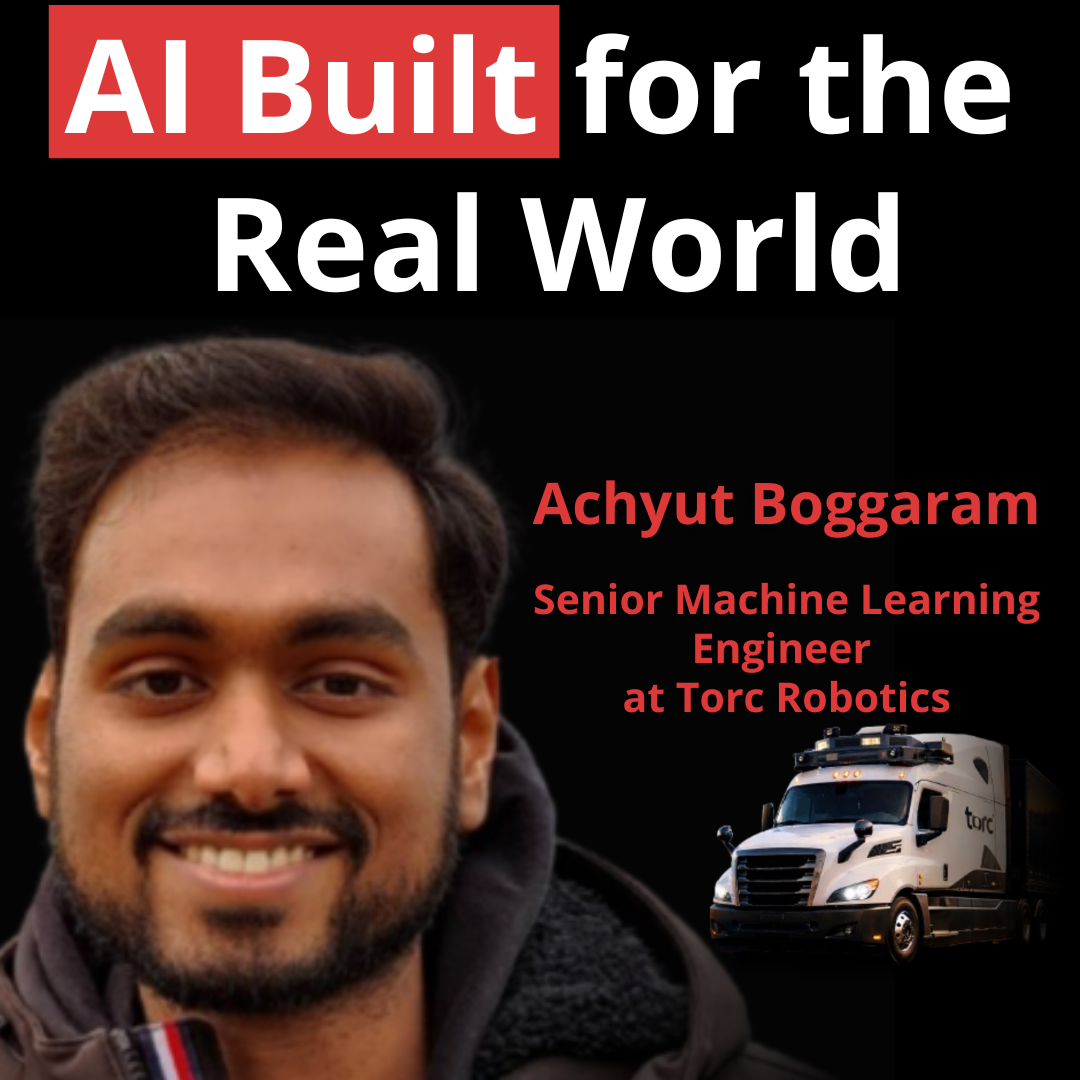
In this episode of An Hour of Innovation podcast, Vit Lyoshin speaks with Achyut Boggaram, a senior machine learning engineer at Torc Robotics, about what it actually takes to build autonomous trucks for real-world deployment.
They explore the engineering reality behind self-driving trucks: the safety requirements, data challenges, and AI limitations that make autonomy far harder than most people assume. Achyut explains how autonomous trucks must operate in unpredictable conditions like fog and low visibility, why even small changes to road signs or traffic lights can confuse AI systems, and how machine learning models are trained to handle edge cases without relying on memorization.
The episode also dives into the scale of the problem, from the massive volumes of sensor data generated during testing to the multi-layered safety certifications required across hardware, software, and machine learning systems. Achyut shares how autonomous trucks are tested, validated, and deployed incrementally, and why the industry treats autonomy more like building a rocket than shipping consumer software.
Beyond the technology, the discussion reframes common fears around automation and jobs, highlighting the growing truck driver shortage and why autonomous trucking is more about filling gaps than replacing people.
This conversation offers a grounded, behind-the-scenes look at autonomous vehicles, cutting through hype to explain why building safe, reliable self-driving trucks is one of the most demanding real-world AI challenges today.


Achyut Boggaram is a senior machine learning engineer focused on applied AI research for autonomous trucking. He has led work on large-scale perception models, sensor fusion systems, and production machine learning pipelines that run directly on self-driving trucks. His expertise spans safety-critical AI, data infrastructure, and real-world deployment, making his insights essential to understanding why autonomy remains so challenging.
Takeaways
- A single missed annotation, like a stop sign or yield sign, can lead to catastrophic outcomes with an 80,000-pound vehicle.
- Self-driving demos work in controlled environments, but real autonomy breaks down once conditions are unpredictable and unstructured.
- Autonomous trucks can generate 600–800 terabytes of data in just 20 minutes due to raw, uncompressed sensor capture.
- Machine learning models struggle to generalize the way humans do, even after billions of miles of training data.
- Safety in autonomous trucking is treated like rocket engineering, with redundancy required at every hardware and software layer.
- Autonomous trucks must run entirely on board without internet access, making real-time decision-making far more constrained.
- When AI is uncertain, the safest response is not intelligence but a minimum risk maneuver, often pulling over or stopping.
- Synthetic and photorealistic simulated data are now essential to train for rare but dangerous scenarios that may never occur in real life.
- Autonomous systems can outperform humans in extreme conditions, detecting pedestrians at long distances in fog or darkness.
- Autonomous trucks are not replacing drivers today, but filling a growing labor gap that could reach hundreds of thousands of unfilled jobs.
Timestamps
00:00 Introduction
02:41 Why Autonomous Vehicles Still Struggle in the Real World
05:40 What It Really Takes to Put Autonomous Trucks on Public Roads
10:05 Safety Certifications That Decide If Autonomous Trucks Are Allowed
15:50 How Self-Driving Trucks Generate Massive Amounts of Data
20:09 How Autonomous Trucks Handle Dangerous and Unexpected Situations
23:20 The Full AI Training Pipeline for Autonomous Vehicles
31:33 The Most Critical Safety Gates in Autonomous Truck Testing
34:21 Breakthrough AI Techniques for Fog, Night, and Extreme Conditions
38:07 The Real Timeline for Autonomous Trucks Becoming Reality
39:52 The Hardest Problems Blocking Full Self-Driving
41:28 Are Autonomous Vehicles Inevitable? Expert Predictions
42:34 Electric vs Diesel Autonomous Trucks: Does It Matter?
43:53 Will Autonomous Trucks Replace Human Drivers?
48:09 Innovation Q&A
Support This Podcast
- To support our work, please check out our sponsors and get discounts: https://www.anhourofinnovation.com/sponsors/
Connect with Achyut
- Website: https://torc.ai/
- LinkedIn: https://www.linkedin.com/in/achyutsarma/
Connect with Vit
- Substuck: https://substack.com/@vitlyoshin
- LinkedIn: https://www.linkedin.com/in/vit-lyoshin/


