Episodes
131
Sept. 29, 2026
How to Know You’re Ready for Product Leadership | Yue Zhao
In this episode of An Hour of Innovation podcast, Vit Lyoshin speaks with Yue Zhao, product leadership coach and creator of The Uncommon Executive, about why strong product managers can struggle when they move into leadership and what has to change before, during, and after that transition. Vit and Yue discuss how a PM can tell whether they are ready for product leadership. Yue argues that readiness is not only about ambition. A stronger signal is whether people already come to that PM for judgment and help beyond their formal area of responsibility. When others pull someone into broader problems, they may already be acting at the next level. The conversation explores why the habits that make someone a reliable PM can become liabilities as a leader. Product managers are often rewarded for solving problems directly, tracking details, and making sure work gets done. Product leaders, by contrast, need to create systems, coach people, build relationships, and make only the decisions…
130
Sept. 22, 2026
Can the Power Grid Handle the AI Boom? | Rob Gramlich
In this episode of An Hour of Innovation podcast, Vit Lyoshin speaks with Rob Gramlich, founder and president of Grid Strategies, about AI data centers, electricity demand, the electric grid, transmission bottlenecks, and why power may become one of the biggest constraints on AI growth. Vit and Rob discuss Grid Strategies’ forecast that U.S. power demand could grow by around 166 gigawatts by 2030, a scale Rob compares to about 15 New York Cities worth of power. They break down how the grid works across generation, high-voltage transmission, and local distribution, and why the U.S. effectively operates through three major grid systems: Eastern, Western, and Texas. The conversation explores why AI data center developers often want power faster than utilities can safely provide it, why transmission lines are difficult to build, and why transformers, turbines, breakers, copper, rare earth minerals, and other equipment have become scarce and expensive. Rob also explains why utilities…
129
Sept. 15, 2026
How AI Can Make Groups Smarter Than Any Expert | Louis Rosenberg
In this episode of An Hour of Innovation podcast, Vit Lyoshin speaks with Louis Rosenberg, CEO and Chief Scientist of Unanimous AI, about collective intelligence, swarm intelligence, AI-mediated group decision-making, and why AI’s best use may be connecting people rather than replacing them. Louis explains why polls, surveys, and votes can aggregate opinions but often fail to help a group deliberate, challenge assumptions, or discover the strongest answer. Vit and Louis discuss how nature solves group intelligence through fish schools, bird flocks, and bee swarms, and why humans are good at thoughtful small-group conversation but struggle when a conversation grows to hundreds or thousands of people. Louis explains how AI agents can observe many small conversations, carry insights between groups, and weave large networks of people into one real-time deliberation. The conversation explores evidence from IQ-test research, radiology diagnosis, forecasting, and problem-solving, inclu…

128
Sept. 8, 2026
How to Use AI Without Losing Your Ability to Think | Jolie Dobre
In this episode of the An Hour of Innovation podcast, Vit Lyoshin speaks with Jolie Dobre, author of Sustaining Human Intelligence: Keeping People Smart, Connected and Innovative in an AI-Driven Workforce, about how AI can speed up work while quietly weakening the human skills organizations depend on. Jolie explains cognitive offloading, skill decay, and why generative AI differs from narrow tools like GPS and calculators: it can take over summarizing, reasoning, ideation, research, and judgment across many domains. Vit and Jolie discuss how individuals can tell whether AI helps them think more deeply or simply does the thinking for them. Jolie shares a practical delegation test: before handing work to AI, ask whether you understand the task, the problem behind it, the goal, and when you last did the work yourself. The conversation also explores why junior employees are especially vulnerable if AI automates away foundational tasks before they build pattern recognition and deliberat…
127
Aug. 25, 2026
What AI Won’t Tell You When It’s Wrong | Jonathan Schaeffer
In this episode of An Hour of Innovation podcast, Vit Lyoshin speaks with Jonathan Schaeffer, founder and CEO of Synsira and creator of Kind, about why today’s AI tools can be useful but still unsafe to trust blindly. Jonathan explains why large language models such as ChatGPT, Gemini, and Claude should not be treated as intelligent authorities, why the word “hallucination” makes fabricated answers sound too harmless, and why a polished AI response can still contain errors users may never catch. Jonathan shares how ChatGPT once generated a biography about him with dozens of mistakes, then appeared to improve later through what he calls band-aids rather than a deeper solution to the trust problem. He explains why training on broad internet data can produce strange or unsupported answers, and why curated datasets can reduce fabrications by grounding responses in information the user controls. The conversation also covers source citations, verification, and why trustworthy AI should b…
126
Aug. 18, 2026
The 250 Million Users Product Teams Ignore | Rebecca Rosenberg
In this episode of An Hour of Innovation podcast, Vit Lyoshin speaks with Rebecca Rosenberg, founder of ReBokeh, about why low-vision accessibility is not niche and what it teaches product teams about adoption and business value. Rebecca explains how her low vision from albinism led her to build a visual-first app that uses a smartphone camera, augmented reality, contrast, brightness, color filters, and AI descriptions to help people customize what they see in real time. Rebecca argues that products often fail because teams build for the wrong user, market to the wrong user, or skip early conversations that reveal what problem actually matters. Her work with ReBokeh shows why accessibility has to be designed around real users rather than assumptions. Low vision is not simply “less blind”; it is a distinct experience where people may still rely heavily on sight but need different tools than audio-only or screen-reader-first solutions. Vit and Rebecca discuss the overlooked size o…
125
Aug. 4, 2026
Why Most AI Projects Don’t Show ROI | Sid Bharath
In this episode of An Hour of Innovation podcast, Vit Lyoshin speaks with Sid Bharath, founder of Refound, about why many AI projects fail to produce measurable ROI and what companies should do before giving work to agents. Sid argues that the problem is often not the model alone, but the way companies approach automation: large AI makeovers, unclear outcomes, incomplete data, missing edge cases, and workflows that were never documented well enough to automate. Sid explains what becoming AI-native actually means in everyday business operations. It does not mean removing humans or handing every decision to AI. It means identifying the repetitive operational layer of work, giving agents enough context and access to execute defined tasks, and keeping people focused on judgment, strategy, creativity, relationships, and review. Vit and Sid discuss how this changes roles inside sales, operations, engineering, customer support, accounting, and startup teams. The conversation also cover…
124
July 28, 2026
The Real Product-Market Fit Problem Is Emotional | Ravi Sawhney
In this episode of An Hour of Innovation podcast, Vit Lyoshin speaks with Ravi Sawhney, founder and CEO of RKS Design and creator of the Psycho-Aesthetics methodology, about why products fail even when the technology works. Ravi explains that product adoption is not only about function, usability, or technical performance; it is also about trust, stigma, identity, emotional resonance, and how a product makes people feel about themselves. Ravi shares a powerful story from his work on the MiniMed diabetic infusion pump, a product that improved quality and length of life but struggled because people felt exposed by its medical appearance in public. That experience helped shape Ravi’s view that successful design must understand the person using the product, the social meaning of adoption, and the emotional signal a product sends. Vit and Ravi also discuss Psycho-Aesthetics, persona resonance, the Hero’s Journey, self-affirmation, and how teams can use deeper human insight to avoid b…

123
July 14, 2026
AI’s Biggest Bottleneck Isn’t GPUs — It’s Power | Sergii Gerasymovych
In this episode of An Hour of Innovation podcast, Vit Lyoshin speaks with Sergii Gerasymovych, founder, CEO, and an AI data center infrastructure operator at EZ Blockchain, about why the next major AI bottleneck may not be models or GPUs, but the physical infrastructure required to power them. Sergii explains how EZ Blockchain is pivoting from Bitcoin mining infrastructure into AI data centers, and why the same lessons from crypto mining now apply to the AI compute race: everyone wants hardware online quickly, but land, power, utilities, transformers, cooling, and construction move much slower than software. The conversation breaks down what an AI data center actually is, why power and land sit underneath the entire compute stack, and why chip supply may be easier to scale than electricity delivery. Sergii argues that companies can manufacture more GPUs, TPUs, and specialized chips, but they cannot print power, accelerate utility studies overnight, or build substations at startup s…

122
July 7, 2026
The Quantum Threat to Encryption Is Already Here | Dr. Shohini Ghose
In this episode of An Hour of Innovation podcast, Vit Lyoshin speaks with Dr. Shohini Ghose, quantum physicist, author, and professor at Wilfrid Laurier University, about what quantum computing actually is and why the most urgent risk may not wait for a perfect large-scale quantum computer. Shohini explains why quantum computing is not simply a faster version of today’s computers. It starts from qubits instead of classical bits, which means concepts like superposition, entanglement, and probability become part of the computing model itself. Vit and Shohini discuss why governments and companies are investing heavily in quantum technologies, why the science is solid but scalability is still difficult, and why most people probably will not own a personal quantum computer anytime soon. Instead, quantum access may look more like cloud infrastructure or specialized services used when a problem has a real computing, sensing, security, or communications bottleneck. They also explore whe…

121
June 30, 2026
The Space Economy Has a Labor Problem | Ethan Barajas
In this episode of An Hour of Innovation podcast, Vit Lyoshin speaks with Ethan Barajas, co-founder and CEO of Icarus Robotics, about why the space economy may be limited less by rockets and more by labor in orbit. Ethan explains why astronauts spend valuable time on cargo movement, maintenance, experiment setup, and routine station operations, and why that work becomes a major bottleneck as commercial space stations, orbital manufacturing, and future space infrastructure grow. Vit and Ethan discuss how Icarus Robotics is building robotic workers for space stations, how teleoperation can become the data layer for autonomy, and why AI robotics in microgravity is very different from robotics on Earth. They also explore what it takes to build a company for a market that is still forming, how founders validate demand before building, and why robot labor could help astronauts focus on science instead of housekeeping. The conversation covers space robotics, commercial space stations, …

120
June 17, 2026
Why Products Win When They Stop Serving Everyone | Krystian Kolondra (SVP at Opera)
In this episode of An Hour of Innovation podcast, Vit Lyoshin speaks with Krystian Kolondra, SVP at Opera, about one of the most counterintuitive ideas in product development: the products that win are often the ones that stop trying to serve everyone. Using the story of Opera GX, the gaming-focused browser that grew into a product used by tens of millions of people, Krystian explains why successful products are built around identity, community, and emotional connection rather than feature lists and broad market appeal. He shares how the Opera GX team discovered an underserved audience, challenged conventional product thinking, and intentionally created a product that some people would love, and others would reject. The conversation explores why niche products can outperform much larger competitors, how product teams should think about experimentation and innovation, and why understanding users at a deeper level is often more valuable than collecting feature requests. Krystian a…

119
June 9, 2026
Is Your Job Safe? The New Diamond-Shaped Career Path
In this episode of An Hour of Innovation podcast, Vit Lyoshin speaks with Taniya Mishra, founder of SureStart and an AI researcher focused on preparing the next generation for an AI-driven future. The conversation explores one of the most important questions facing students, professionals, educators, and leaders today: what does it actually mean to be AI literate? Taniya explains why simply using tools like ChatGPT is not enough and why understanding how AI works, where it succeeds, where it fails, and how to evaluate its outputs will become essential skills in the years ahead. Vit and Taniya discuss how artificial intelligence is transforming education, hiring, and the workforce. They examine the growing expectation that employees will work alongside AI agents, why analytical thinking and decision-making may become more valuable than technical skills alone, and how traditional career paths could evolve as AI automates more entry-level work. Taniya introduces the idea that the w…

118
May 26, 2026
Why Enterprise AI Fails After the Demo | David Bauer
In this episode of An Hour of Innovation podcast, Vit Lyoshin speaks with David Bauer, co-founder and CTO of Axonis, an AI systems architect, and an expert in federated AI, enterprise security, and large-scale predictive analytics, about one of the biggest hidden problems in enterprise AI: why most AI projects fail after the demo. David explains how companies often build impressive AI prototypes using small, controlled datasets, only to discover that real-world production environments are far more fragmented, insecure, and difficult to integrate. The conversation explores the “last mile” problem in AI, why centralized data lakes frequently become unusable “data swamps,” and how federated AI architectures allow organizations to securely bring AI directly to production data instead of moving sensitive information into centralized systems. Vit and David also discuss the growing role of AI agents in enterprise workflows, the cybersecurity risks created by large language models, and …

117
May 19, 2026
The Framework for Building AI-Native Organizations | Melissa Reeve
In this episode of An Hour of Innovation podcast, Vit Lyoshin speaks with Melissa Reeve, AI transformation strategist and author of the book Hyperadaptive, about why most companies are approaching AI the wrong way. Rather than treating AI as just another software upgrade, Melissa argues that AI requires a complete redesign of how organizations operate. The conversation explores why traditional enterprise structures struggle to adapt to AI, how agentic workflows are reshaping jobs and decision-making, and why organizations must move toward continuous learning, value streams, and adaptive operating models. Melissa breaks down her five-stage Hyperadaptive framework, which helps organizations evolve from early AI experimentation to fully AI-native operations. She explains how AI-powered decision-making, integrated learning loops, AI governance, and organizational sensing systems will fundamentally change the future of work and enterprise leadership. Vit and Melissa also discuss w…
116
May 12, 2026
DEXA Founder: Why Drone Delivery Is Bigger Than Amazon
In this episode of An Hour of Innovation podcast, Vit Lyoshin speaks with Beth Flippo, CEO and founder of DEXA, one of the few FAA-certified unmanned airlines in the United States, about the future of autonomous drone delivery and how it could fundamentally reshape logistics, commerce, and everyday life. Beth explains why drone delivery is no longer just a futuristic concept, but a rapidly emerging industry built on advances in autonomous systems, aviation regulation, robotics, and AI-powered logistics. The conversation explores how DEXA built an end-to-end drone delivery platform, why strict FAA certification became a competitive advantage instead of a barrier, and what it takes to operate autonomous aircraft safely at scale. Vit and Beth also discuss the economics behind last-mile delivery, why 15-minute autonomous delivery could change consumer behavior, and how future delivery systems may no longer depend on roads, drivers, or even fixed addresses. Beth shares insights into …
115
May 5, 2026
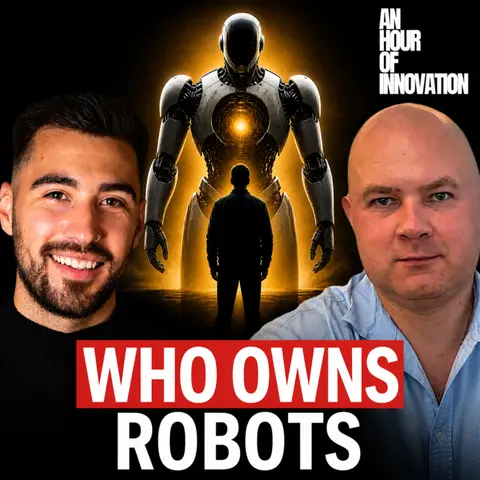
XMAQUINA Founder: Why Robots Will Replace Jobs, But Make Owners Rich
In this episode of An Hour of Innovation podcast, Vit Lyoshin speaks with Mauricio Zolliker, co-founder of XMAQUINA, about the rise of robotics, AI agents, and the emerging machine economy. Mauricio explains how we are entering a new phase where robots are no longer just tools, but are evolving into autonomous economic agents capable of earning, spending, and participating in markets. He outlines the transition from corporate-owned robotic systems to a future where individuals can own machines that generate income, fundamentally reshaping how value is created and distributed. The conversation dives into the infrastructure required to support this shift, including why traditional financial systems are not built for machine-to-machine transactions and how blockchain and decentralized systems could enable real-time, low-cost, programmable payments. Mauricio also shares his perspective on the concept of “machine capital,” where robots move from being a cost to becoming income-genera…

114
April 28, 2026
We Can Cure Diseases… So Why Doesn’t It Scale?
In this episode of An Hour of Innovation podcast, Vit Lyoshin speaks with Tara Austraat-Churik, partner at Blue Matter, and a biotech and pharma expert working at the intersection of AI, drug discovery, and clinical development. Vit and Tara explore how AI is transforming the entire pharmaceutical lifecycle, from early-stage research and molecular design to clinical trials and regulatory processes. Tara explains where AI is already delivering real impact, and where the biggest bottlenecks still exist, especially around fragmented data, scalability, and operational complexity. A key theme of the conversation is the paradox of modern healthcare: we already have technologies capable of curing diseases in a single treatment, yet these breakthroughs remain difficult to scale and access. Tara breaks down the challenges behind cell and gene therapies, including manufacturing constraints, high costs, and the limitations of current healthcare and reimbursement systems. The discussion …

112
April 14, 2026
AI Projects Are Failing | Here's What Everyone Gets Wrong
In this episode of An Hour of Innovation podcast, Vit Lyoshin speaks with Max Vermeir about why so many AI initiatives fail in real-world business environments, and why the problem is rarely the LLM models themselves. Max explains that while large language models have advanced rapidly, most organizations struggle because their data is messy, unstructured, and not ready for AI to use effectively. From documents and spreadsheets to complex workflows, the real challenge lies in turning human-generated data into something machines can reliably interpret. The conversation explores the difference between deterministic and probabilistic AI, highlighting why LLMs always produce an answer, even when it’s wrong, and what that means for trust and reliability in production systems. Max also shares practical examples where simpler solutions outperform complex AI models, emphasizing the importance of choosing the right approach instead of defaulting to AI for every problem. Vit and Max dis…

111
April 7, 2026
Why the Real Opportunity in Space Isn’t Rockets
In this episode of An Hour of Innovation podcast, Vit Lyoshin speaks with Denis Kalyshkin, a venture capitalist focused on deep tech and the space industry, about how space technology is rapidly evolving from exploration into a data-driven economy. Denis shares how the dramatic drop in rocket launch costs has unlocked a wave of innovation, making space more accessible than ever before. What was once limited to governments and a few large players is now opening up to startups, engineers, and even students. As a result, thousands of satellites are now orbiting Earth, generating massive amounts of data that can be used across industries, from agriculture and climate monitoring to competitive business intelligence. The conversation shifts from infrastructure to opportunity, highlighting how the real value in space is no longer in building rockets, but in analyzing and applying the data collected from orbit. Denis explains how Earth observation is becoming a powerful tool for decisio…

110
March 31, 2026
Nobody Talks About This Risk in AI Innovation
In this episode of An Hour of Innovation podcast, Vit Lyoshin speaks with Jake Ward, co-founder and chairman of Developer Alliance, about the evolving relationship between innovation, artificial intelligence, and government regulation - and why it matters more than most developers and founders realize. Jake shares his perspective from working at the intersection of developers and policy, explaining how regulation increasingly shapes what can be built, how products operate, and whether startups can survive. He highlights the growing tension between the rapid pace of AI innovation and the slower, often reactive nature of government decision-making. Through real-world examples, the conversation explores how a single law can fundamentally change or even eliminate a business model overnight. Jake emphasizes that while regulation plays an important role in protecting individuals and society, it often struggles to keep pace with rapidly evolving technologies, leading to unintended cons…

109
March 24, 2026
Why Mechanical Prosthetic Hand Outperforms Advanced Robotics l Fergal Mackie
In this episode of An Hour of Innovation podcast, Vit Lyoshin speaks with Fergal Mackie, founder of Metacarpal, about a surprising reality in prosthetics: despite decades of innovation, many advanced devices are not being used. In fact, nearly half of upper limb prosthetics are abandoned, revealing a critical gap between technological progress and real-world usability. Fergal shares how most of the industry has focused on increasingly sophisticated robotic hands, adding features, sensors, and complexity, while overlooking what users actually need: reliability, durability, and intuitive control. His work takes a different approach, rethinking mechanical, body-powered prosthetics and enhancing them with capabilities traditionally associated with robotics, but without the fragility and learning curve. The conversation explores why simpler solutions often outperform more advanced ones, especially in real-life environments where consistency and trust matter more than cutting-edge fun…

108
March 17, 2026
Why Self-Driving Trucks Are So Hard! Data, Sensors, AI & Real-World Driving
What does it actually take to build self-driving trucks that can interpret the real world and react faster than humans? In this episode of An Hour of Innovation podcast, Vit Lyoshin speaks with Achyut Boggaram about what it really takes to build autonomous trucking systems that operate safely in the real world. Rather than focusing solely on AI breakthroughs, the conversation highlights a deeper reality: deploying self-driving technology is fundamentally a systems engineering challenge. Achyut explains how autonomous trucks rely on a combination of sensors, data pipelines, machine learning models, and traditional rule-based systems working together. At the core is not just intelligence, but reliability, especially in rare and unpredictable situations. These long-tail scenarios, which may occur infrequently but carry high risk, are the primary focus of modern autonomous system development. The discussion explores how safety is embedded into every layer of the system, from moti…

107
March 10, 2026
Daylighting Technology: Why Natural Light Is the Future of Sustainable Buildings | Neall Digert
In this episode of An Hour of Innovation podcast, Vit Lyoshin speaks with Neall Digert, Vice President at Kingspan Light + Air, about how daylighting technology is transforming the way buildings use natural light. They explore how modern architecture can capture and redirect sunlight to illuminate indoor spaces, reducing the need for electric lighting while improving the experience of the people inside those buildings. Neall explains the science behind daylighting systems, including technologies that collect sunlight on rooftops and transport it through reflective tubes into interior spaces. Unlike traditional windows, these systems allow architects and engineers to control how light is distributed inside a building, focusing it where it’s needed, diffusing it across large work areas, or highlighting architectural features. The goal is not just energy savings, but creating environments that support human health, comfort, and productivity. The discussion also explores the broader…