

 YouTube

 Spotify

 Apple Podcasts

 Amazon Music

 iHeartRadio

 Castbox

 Overcast

 RadioPublic
Spatial Computing Explained: AR, VR, Geospatial, Digital Twins & AI World Models | Jake Steinerman
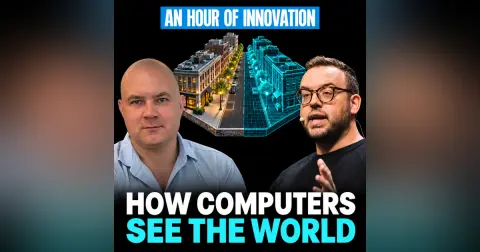

How does your phone know where to place an AR arrow on a real street, and what makes a digital copy of the world useful?
In this episode of An Hour of Innovation podcast, Vit Lyoshin speaks with Jake Steinerman, a spatial computing practitioner working in developer relations at Cesium, about the technology that connects digital experiences to physical places. Jake explains how augmented reality can recognize a room, object, or street; how geospatial data and digital twins help people see and monitor real infrastructure; and where AI world models could help build and test simulated scenarios.
You’ll learn
* What spatial computing means beyond the headset buzzwords
* How augmented reality differs from virtual reality and mixed reality
* Why you can experience useful AR on a phone, not only through glasses
* How an AR object can stay attached to a book, machine, desk, or street
* How Google Maps combines location, direction, and visual matching for AR walking directions
* Why Jake built a Google Glass concept to detect drowsiness while driving
* What can make VR movement uncomfortable and how developers respond
* Why virtual training can help people rehearse work on complex equipment
* How geospatial data differs from a digital twin
* What sensor readings and inspection data add to a 3D model of a bridge or building
* How AI has accelerated Jake's prototyping work and what world models aim to simulate
* Where a curious builder can start experimenting with VR, AR, and Cesium's geospatial tools
Jake Steinerman is an engineer and developer-relations practitioner who has worked across Google Glass, enterprise augmented reality, VR games and creator platforms, Meta's developer ecosystem, and Cesium. His hands-on experience shows what these technologies require behind the scenes: tracking the physical world, connecting models to useful data, and deciding whether a simulation answers a real question.
Timestamps
00:00 Introduction
01:31 What Is Spatial Computing?
03:18 AR vs VR vs Metaverse vs Digital Twins
05:40 Do You Need a Headset for AR and VR?
10:18 From Google Glass to Meta: 10 Years in XR
19:39 How Augmented Reality Tracking Works
26:20 Drive Safe: Google Glass Drowsiness Detection
31:01 Virtual Reality vs Augmented Reality
33:17 VR Motion Sickness Explained
37:06 VR Training: Do Skills Transfer to Real Life?
42:22 Geospatial Data and Digital Twins
45:39 Where Geospatial Data Comes From
49:06 AI and World Models in Geospatial
54:11 How to Start Building in XR and Geospatial
57:23 Innovation Q&A
Connect with Jake
* Website: https://cesium.com/
* LinkedIn: https://www.linkedin.com/in/jasteinerman/
* X: https://x.com/jasteinerman
* Other: https://jasteinerman.lovable.app/
Connect with Vit
* Substack: https://anhourofinnovation.substack.com/
* LinkedIn: https://www.linkedin.com/in/vit-lyoshin/
* X: https://x.com/vitlyoshin
* Website: https://vitlyoshin.com/
Support the podcast
Enjoy the podcast? You can help us keep bringing you interesting stories and conversations.
Some links are affiliate links, which means we may earn a small commission if you make a purchase or sign up, at no extra cost to you.
Explore our sponsors and recommended tools:
https://www.anhourofinnovation.com/sponsors/
Interested in sponsoring the podcast?
Reach out to us at iris@anhourofinnovation.com to explore partnership opportunities.


