

 YouTube

 Spotify

 Apple Podcasts

 Amazon Music

 iHeartRadio

 Castbox

 Overcast

 RadioPublic
AI Made Building Faster. Why Is Shipping Better Products Still So Hard | Jeff Keyes
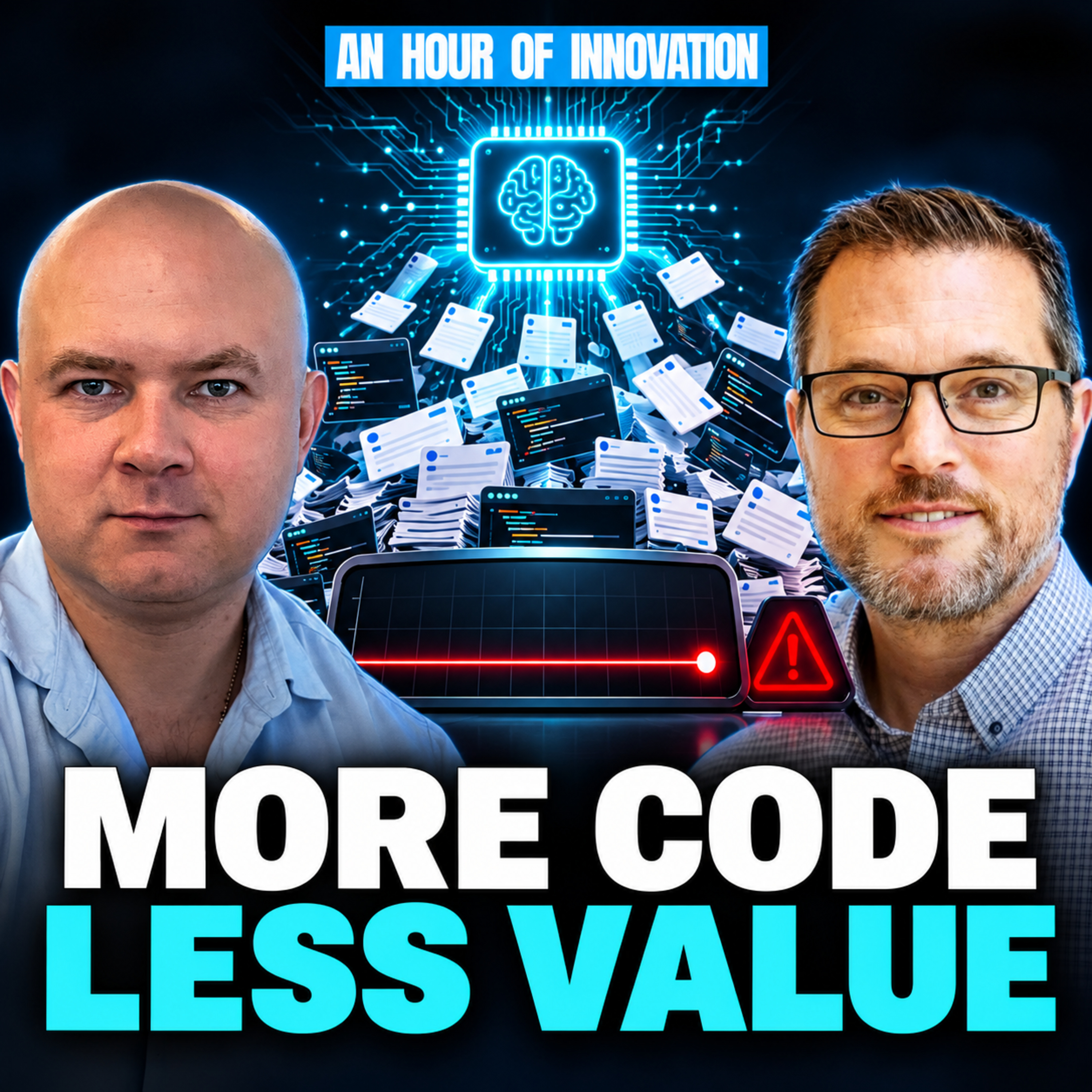
In this episode of An Hour of Innovation podcast, Vit Lyoshin speaks with Jeff Keyes, Field CTO at Allstacks and a product and go-to-market leader, about why AI can help product teams build the wrong thing faster when companies measure output instead of customer value.
Vit and Jeff discuss the pressure many software organizations now feel to prove ROI from AI tools. Jeff explains why the easiest metrics, more lines of code, more pull requests, more tickets, more user stories, and more shipped features, can be misleading. A team can produce more work and still fail to improve adoption, usage, retention, revenue, or the customer experience.
The conversation explores what AI slop looks like inside real product teams. Jeff argues that AI-generated requirements can become the same weak user stories with four times more text, and that polished documents do not automatically mean clearer thinking. He connects this to product management discipline: understanding the customer problem, deciding what not to build, testing ideas earlier, and using evidence before committing engineering time.
Vit and Jeff also cover the relationship between product management and product marketing. Jeff explains that product management keeps product-market fit by improving the product, while product marketing gets the right people to care by translating customer pain into a resonant story. For startups and SaaS teams, both sides need to work closely together.
The episode closes with a practical framework for using AI better: define a North Star, clarify what “better” means, rank ideas, run small experiments, check the outcome, and improve in compounding steps. Jeff’s message is not anti-AI. It is a warning that AI makes product judgment more important, because faster building only helps if the team is building something customers actually value.
Jeff Keyes has worked across product management, product marketing, and engineering. His work focuses on helping teams build better products, connect product decisions to customer value, and use evidence instead of output metrics to understand whether they are actually improving.
You’ll learn
- Why many companies measure AI productivity with the wrong scoreboard
- Why lines of code, PR count, and feature volume can be misleading AI ROI metrics
- How AI-generated user stories can become the same weak requirements with more text
- Why product managers need to focus on customer value, not just output
- How Microsoft Office’s ribbon redesign shows the importance of prioritizing what users actually use
- Why on-time and on-budget delivery does not prove a product created value
- How the product manager’s job changes when AI speeds up execution
- What AI slop looks like in product management, product marketing, and engineering
- How to use AI better by organizing ideas, ranking themes, and applying frameworks
- The difference between product management and product marketing
- Why startups may need product marketing earlier than they think
- How teams can define a North Star and use evidence to test whether AI is actually helping
Timestamps
00:00 Introduction
01:17 AI ROI: Value Over Output
05:34 Why Leaders Prioritize Speed
16:12 How AI Is Reshaping Product Management
22:01 The Expanding Product Manager Role
24:54 What AI Slop Means for Product Teams
29:22 A Better Workflow for LLMs
32:10 Product Management vs. Product Marketing
37:30 Aligning Product and Product Marketing
41:09 Building Product Marketing Skills
43:49 Using AI for Better Execution
48:05 Augmented Intelligence and Critical Thinking
49:52 Innovation Q&A
Connect with Jeff
- Website: https://www.allstacks.com/
- LinkedIn: https://www.linkedin.com/in/jeffdkeyes
Connect with Vit
- Substack: https://anhourofinnovation.substack.com/
- LinkedIn: https://www.linkedin.com/in/vit-lyoshin/
- X: https://x.com/vitlyoshin
- Website: https://vitlyoshin.com/
Support the podcast
If you enjoy the podcast, you can support it by exploring the tools below.
These are affiliate links, meaning the show earns a small commission at no extra cost to you.
- MeetGeek: Record, transcribe, summarize, and share insights from every meeting.
- Amplemarket: Step into the future of sales: Human + AI. Empower reps, uncover opportunities, and grow revenue.
- Databox: Turn business performance data into clear answers your team can understand, explain, and act on – instantly.
For inquiries about sponsoring An Hour of Innovation, email iris@anhourofinnovation.com
Episode references & glossary
Microsoft Office
https://www.microsoft.com/microsoft-365
Microsoft Office is discussed when Jeff recalls the Office ribbon redesign and the challenge of deciding which features users actually need most.
Jensen Harris
https://jensenharris.com/
Jensen Harris is mentioned by Jeff as a product and UX leader involved in the Microsoft Office ribbon work.
Technology Business Management Council
https://www.tbmcouncil.org/
Technology Business Management is referenced when Jeff discusses enterprise planning, CIO conversations, and how companies judge technology investments.
ChatGPT
https://chatgpt.com/
ChatGPT is mentioned by Vit as one of the LLM tools people use when discussing AI-generated content and product work.
Google Gemini
https://gemini.google.com/
Gemini is mentioned by Vit as another LLM tool people use when discussing AI-generated output.
Claude
https://claude.ai/
Claude is mentioned when Vit and Jeff discuss LLMs, prompting, and using AI tools for critique and writing workflows.
WhisperFlow
https://wisprflow.ai/
WhisperFlow is mentioned when Jeff discusses voice interaction and the possibility that typing may feel outdated in the future.
Evidence Guided
https://www.amazon.com/Evidence-Guided-Creating-Impact-Products-Uncertainty/dp/B0CJDFBN1X
Evidence Guided is the product book Jeff references when discussing evidence-based product work and the GIST framework.
Vit Lyoshin (00:00.889)
Welcome Jeff. Thank you for your time today.
Jeff Keyes (00:04.312)
Thanks. Glad to be here.
Vit Lyoshin (00:06.521)
Yeah, of course. so when we talked last it you mentioned something about that AI can make teams work faster but build their own thing fast. can you give me some examples or maybe just elaborate a little bit on what you see in it in general and what they're trying to do that they, you know, fail.
Jeff Keyes (00:31.724)
Well, I I mean, first and foremost, part of my job is to talk to a lot of different product and engineering teams themselves as we offer Product Studio a tool to help them in the journey of building stuff. One of the most dominant things I hear is must show ROI of all the AI investments that these teams are making. And behind the scenes, there's sort of this executive push that you hear through all these people, where it is in essence.
Because we're spending money on you, and now you have these AI tools, therefore you should be faster. And so the result, the North Star that they look at is: well, before you produced 27 widgets. Now with AI, because we're investing in that, because we're so cool, you better be perform, you know, producing 35 or 40 widgets, because that is better. And
Indeed, what we find as I've talked to these organizations, like, well, so are you finding the ROI? And they're like, well, how do we measure the ROI? Well, you would measure that by more consumption, adoption, usage, and ultimately revenue. And the most ironic part is getting the answer of, well, we don't really measure that. To which my response is like, How in the world do you
No, if you're building the right thing. And how do you know if it's doing better? You might be building more stuff, but is it right or wrong? And it's not necessarily answering your question, is it the wrong thing? It's just that the success metric has focused on on producing more widgets. I had another conversation where the AI ROI conversation came up and the discussion was must show executive leadership how many lines of code we produced.
I mean, take widgets to the next granular fact and we'll say, well, before each developer produced this many lines of code and now they produce this many. So it must be better, right? Somehow we've gotten out of this world of really understanding the right thing that we should build and why. Going back to the roots of what is product management, there are a number of frameworks that look at product market fit and analyzing the kinds of things we would invest into and are we building the right stuff.
Jeff Keyes (02:53.826)
The problem is there's such emphasis on speed and just getting stuff out the door. It's dizzying with almost a a fever pitch of let's deliver a bunch of stuff that almost like I want to say nobody cares if they're building the right thing. Hey, we got more stuff. Cause an executive said we're supposed to build this more stuff. Where it comes out is when you you see the the question of well, it's not really resulting in producing more.
Vit Lyoshin (03:00.74)
Mm-hmm.
Jeff Keyes (03:22.572)
value for customers that returns net money or consumption or usage. And so I think that's the question you restart to zero in on like, did we deliver more value? And did it show up because we have evidence that they produced the right thing, as demonstrated by these different factors. And so it goes all the way back to the North Star that I think people are pointing to of of what they're looking at.
Vit Lyoshin (03:34.544)
Mm-hmm.
Vit Lyoshin (03:49.691)
Yeah.
Jeff Keyes (03:50.755)
I don't mean to be on a rant, but one more on that is another thing I hear all the time like, hey, do your user stories, you know, are they good that come into the engineering team? It's like, no, they really suck. Like, dude, you got AI that's with the product team. Like, they're using AI to build all these user stories. Like, yeah, now they're the same sucky stuff, except it's got four times the amount of text and they're big bloated, and I can't even freaking tell what it means. Is that producing?
Vit Lyoshin (04:18.405)
Yeah.
Jeff Keyes (04:19.862)
More stuff? Is that better?
Vit Lyoshin (04:23.641)
Yeah, well I was gonna follow up and say like seems like the incentive is wrong. So developers and teams have to produce more and more stuff in the same time. but the question is exactly right, like why are you building all this stuff? Who needs it? Who wants it? Does it even make sense? And we know from ex from experience that sometimes when you release too much to people, they get overwhelmed and they abandon your product because
I certainly don't like when somebody changes the thing I'm using too often and every week it's a new UI, it's a new button, it's a new section or it's a new feature, and I have to learn it. it drives me nuts. So I don't really appreciate that frequent change myself. and I I just don't know. Do you know what's going on with leaders, why they push on their speed so much versus anything that is more you know, more tangible, I guess, or more ROI driven.
Jeff Keyes (05:20.854)
You know, it's a I think there's a business conversation that's happening in every software organization right now. There's a certain amount of spin that's happening on dev teams and QA and test and design and all that. And then now there's a new element where the the cogs of of an entire building something was primarily the cloud infrastructure and the people.
Now enter this really expensive thing of AI. Go look at the token usage that any of us use and evaluate how much is that? Is that a is that half my my salary? Is it a quarter? I mean, it's it's not a 1%, it's far more than that. That's now hit a a high enough level where CIOs and people that are managing the money are having to push back and say,
Look, we just increased our spend on what we're doing. I people are not. I don't care. I have an overall revenue number and cost profile to match to that revenue number to show that we're fitting the right profile of Ibadah and the rest of those kinds of things. So demonstrate that we're adding more value to the business for what we're spending, which has then led to the conversation of like, well, let's go prove the R ROI of of the AI.
Which of course the easiest thing is is to ask for like, well, how much better are we? Versus are we producing more value that are resulting in more revenue? Because that's takes time to get to that point. So I don't know. I I really hope this change I hope it someday and sometime in my life, I hope somebody stops asking for stupid metrics like lines of code that AI generated or how many additional PRs were generated, or I I
Goodness gracious. It it is to say like a a marketing dock is better if it's longer 'cause it produced that much more. I mean, no one would say that's a good thing. But yet in the in development world, well of course you produce more, must be better.
Vit Lyoshin (07:27.001)
Yeah, it's interesting because in content and specifically when I started working on this podcast, I realized that it's kind of in everything I write and produce, the shorter it gets, the harder it is. So I think the value is actually in producing something very concise but that makes sense and it's clear and people can get it, versus listening for something for a very long time or reading something for a long time. And I think the same should be with products and with code.
you release two or three features that really are desired by your customers versus ten that nobody cares about. Or maybe they care about but they're nice to have, right?
Jeff Keyes (08:07.01)
Well, and isn't that the whole point of what product management should be transforming into instead of just build more features? It's be super expert at at ferreting out those things that should be built. And the most power you wield as a product manager is to shelf some things that, yeah, you probably shouldn't, you know. I I remember I to that point, like I was on the Office team when, you know, Microsoft Office when we implemented the ribbon.
Vit Lyoshin (08:27.652)
Yeah.
Jeff Keyes (08:36.29)
the the whole change in in the menu structure. And, you know, before if you remember you had the file menu, the edit menu, and then the help menu and a whole bunch of menus in b in line. There were so many features at the time in the race for the office suite that it always became like you you ship the next version of whatever it was. And at the time I was working with the Outlook team and it was like, okay, you you have to add in this version, you know, X number of new features because of course those new features are going to be more.
Vit Lyoshin (08:47.205)
Mm, mm-hmm.
Jeff Keyes (09:05.122)
When we got into analyzing the ribbon, Jensen Harris was the was the UX and and product person that was helping drive that feature. But came to this discovery that as he was analyzing, like where do you put the new buttons? Like if I'm gonna have these new menu items are gonna be really cool, and these menu items are gonna be sort of live widgets in the menu. So, I wanna change the styling to this when you actually see the styling versus some archaic menu thing that was disconnected from what was on the screen. That was the idea.
So the question was, well, which which items do you put where? So we kicked off an exercise, and this was across the entire Microsoft Office suite, where we we looked at not only one, what features do most people use? That was an interesting exercise. And the second one is how often do they use them? What we found is that more than I I'll forget the numbers and I'm getting this wrong. You can go look this up, but it was in the ballpark of
More than most people used no more than 10% of all of Word or Outlook at that point. And everything else was like these extra stuff. So the point from a visual point of view was let's take those things that are most common, that most common 10%, and make that front and center in the ribbon. So that when you look at the ribbon, like if you want to print, that's right there. If you want to change format, if you want to change your fonts, or if you
spell check back in the day when you had that in Word, for example. That was, gotta put that up front. and everything else was not. We we learned where those features were by tracking eye usage and then doing some metrics on it. The point is, is somehow so many organizations have gotten away from this idea of looking at how well things are done. I worked, sorry, I'm all sorts of stuff today, but I I worked in a space called portfolio
Vit Lyoshin (10:37.241)
Mm-hmm.
Jeff Keyes (11:01.56)
Program portfolio management, right? Project portfolio management. Sorry. It's the business in bigger companies where they lay out all the projects and the investments for the year. Used to be an annual planning process. And then with the year they'd say, Well, we think this number of things are going to change the business. And so we're going to put X million here and X million here. Typically the CIO would like, I'm cutting everything by 10%. I got my special projects. I'm going to fund here. And they would go to town.
Vit Lyoshin (11:05.135)
Mm-hmm.
Jeff Keyes (11:27.342)
It's practice still happens today in most enterprises. There's some level of this. Hopefully it's happening more on a quarterly basis, but you know, so forth. I went to the technology business management conference, where is the most condensed group of CIOs that I've ever been in the room with. it's a big conference, if you've never heard of it. and w the most interesting question was asking, because I was just like pulling, like, hey.
Vit Lyoshin (11:36.251)
Mm-hmm.
Jeff Keyes (11:56.425)
Now that you've laid all these things out, do you look at the results? And that was the interesting question. The answers were, yes, we measure these projects by did they come in on time and under budget? That's success. And others were, no, we just we're too busy because we got to move on to the next planning cycle. We know what we have to get done.
Vit Lyoshin (12:12.259)
Yeah.
Yeah.
Vit Lyoshin (12:21.945)
Yeah, exactly, yeah.
Jeff Keyes (12:24.066)
So I mean it's sort of akin back. Remember the days when like you'd ship stuff and you'd be like, well, did it blow up production? No, we're good. That was successful. Or what was our bug rate for this thing? it was less than the bug rate for the last thing we built? Good. We're we're good. Is that really how we're gonna measure success of of anything, even AI? And if we get there faster and we didn't blow up production, is that success? I mean, I can
Vit Lyoshin (12:39.435)
Right.
Jeff Keyes (12:51.202)
Dude, I tell you, I can take any code line and create a whole bunch of comments, check those in and get that out faster than anybody else. And would that be successful? It it a mind ball blown, frankly, that this is where we continue to talk.
Vit Lyoshin (13:05.711)
Yeah, this is very interesting and it reminds me of so many conversation I had with people when exactly that's what happens. So everybody managed to the due date and to the budget, but nobody cares to ask users like was it helpful to you? Did it make sense to you? Like, did you want it even? Or we just came up with some random ideas and now forcing you to start using it. That's very interesting. it's yeah.
Jeff Keyes (13:19.724)
Right.
Jeff Keyes (13:30.839)
Yeah. Which used to be okay, right? I mean, it used to be like because the cycles were so long, you'd be like, I'll just live with it, but not anymore. People have so many choices, including, you know what, I got a little problem on my own machine and my workflow and my finance department or my sales side or product ops or wherever I sit. I can automate that myself using Claude. If there's some bigger system and it's not supported, well, fine, I'll just go build it. People are making
Vit Lyoshin (13:38.66)
Yeah, yeah.
Jeff Keyes (13:58.453)
micro decisions about what they use every single day. And if it's not saving me time or clunky or doesn't work, I'm out. I'm just going to do this myself. It it reminds me of why the practice of product management is so important today, more so than it was before. AI is such a tool for figuring out solutions to problems. What people don't typically a ask AI about typically is like, well, what's the problem we're trying to solve?
Vit Lyoshin (14:06.683)
Yeah.
Jeff Keyes (14:28.814)
And, you know, help me understand the pain point of that and options of what it would look like in a new world. and then the actual customer research of exploring a few of those options to figure out, you know, what's the value of of building something like here? Would you know, it instead of just expecting like if you build it, they will come. Why not test? Instead, we test by building it all the way out for production, handing it to people and seeing if they use it. no, that's okay.
Vit Lyoshin (14:51.472)
Mm-hmm.
Jeff Keyes (14:58.658)
Just move on and start building the next thing.
Vit Lyoshin (15:01.487)
Yeah, let's talk about this a little bit for the changes in the job. because I think many people are still confused and don't know what this really means. Everybody's using AI for like we can write more tickets, we can make them look perfect and follow certain formats and and whatnot. But what actually is expected of product managers these days using AI tools to help them actually
you know, be better and provide more value to the users.
Jeff Keyes (15:34.157)
That's a great question. What's expected of product management today versus what was expected before? I think there's some massive shifts. One, the the amount of context that a product manager has to hold in their head now is far beyond what they've ever been expected to do for a couple of reasons. Typical product cycle, I remember remember like Microsoft Office, we'd ship every three years. my gosh.
Vit Lyoshin (16:02.491)
Yeah.
Jeff Keyes (16:03.47)
Can you imagine? Like the next version's gonna come out in in three years, right? And like, what cool things we got. No, now stuff's like you said, it's gotta come out so fast. In gathering context and making decisions, you got a lot of time. You got a lot of time where you can sort of move forward on a solution, gather some context that's gonna address it up here, make some decisions, go forward, do some testing, go back, fix those things. Not anymore.
Vit Lyoshin (16:10.831)
No.
Jeff Keyes (16:31.52)
Like whatever was in your backlog, the dev team's making decisions on and moving forward on, and they're showing you stuff and like, hey, we we think this will work. It will it? you better know. And having the context of customer conversations, incidences, how the code works, the problem space that you're solving, the the kind of strategic direction that you're hoping to achieve achieve, the where you're getting your money.
understanding the changing roles of how AI will affect your customer and how your product fits into that, incorporating more of those tools in. my gosh, that's bigger than most people's head. And now you kind of have to have tools to help manage that context because you're not going to get any other way. Second thing that I see changing a lot is the expectations of product. Like as a as a product guy or gal, you gotta gotta know your
Analytics, you gotta know your results, people are questioning things. You have to have it sort of upfront at your fingertips, being able to measure what's happening at any point in time. You're not going to somebody say, Hey, can you summarize what you're hearing from your customers and then come back a week later? No, you need everything right now. You need to be able to go and say, What's been the buggiest area of the product and how does that go? Third thing is the expectation to get it right.
I've heard this described as the you know, if if you've got a a pod that builds software, which is the dev, PM, and design. And, you know, of course there's other kind of other folks that sit around that, but that being the core trio that takes any kind of feature forward. you know, the dev, what's the dev do? Focus on the solution, right? What's what's design do? Focus on the solution. What's product do? Focus on the problem and the solution.
Vit Lyoshin (18:12.688)
Uh-huh.
Jeff Keyes (18:28.118)
And so the challenging part of product now is understanding where those problems are and understanding them well enough that they can inspire solutions. But now the expectations isn't just like, hey, you've got a good idea. Let's go build this thing all the way out, ship it and see if it works. No, no, no. I know that software's getting cheaper, but there's a lot of bloat in that. Go test it first. one of the
a buddy of mine, he leads a team of 20 PMs and his his goal is every PM every week should have a couple of mock-ups and builds that they're doing that they're testing with customers. They'll get feedback on those and a few of them elevate up and then they go through the product process where now we're gonna build it for real instead of some mock-up. Which brings me to another point of how product is changing. you gotta be able to mock stuff up. You can't wait for a designer. You need to know your design system, you need to get close enough.
You send it through a designer and you're interact. You know, you'll you you gotta know how to use the tools to to build mock software enough to get the concept across to to prospective customers and and and actual customers where they'll give you feedback on it and incorporate that. And that's part of it. I think there's another other big change. So the vibe coding it. And one final one comes in the form of of really when your product
Is largely a prompt. Well, how do you know if your prompt is good? Hey, you think of all what what's the user experience of anybody's prompt? And is it better? I mean, it's just doing some stuff. You know, you you prompted to create something. Was it good? Do you know? The idea that you need something that will sit on top of everything you do.
Vit Lyoshin (20:04.29)
Uh-huh.
Jeff Keyes (20:18.674)
And or everything your customers do and sort of rate how well did your tool react to it. Because now you're not necessarily building a tool that your customers interact with. You're building an agent that your customers interact with. And so you need a scorecard for your agent, evals. This is the whole thing about evals. So I better build an agent that's going to watch my agent, and then I better do some scoring reviews and update my agent so he does better. Product managers own this, have to own it. So
Vit Lyoshin (20:31.472)
Yeah.
Vit Lyoshin (20:34.809)
Mm-hmm.
Jeff Keyes (20:47.158)
Massive changes with AI in the world of product.
Vit Lyoshin (20:47.395)
Yeah.
I'm also thinking while you were saying that it is a lot for a single person and I know there are teams of product managers and they somehow slice the responsibilities and things like that, but still it's a lot because you have you just your day to day is so so many different things you do basically.
And with AI, it's even more of that because I find myself sometimes just chatting with my tools and giving them tasks and I already forgot what I asked them about. So I need to I ask them like remind me about what I asked you before, it's going crazy. So I'm almost thinking like we should probably split product teams even smaller and give them even smaller pieces because it's it's becoming almost impossible to manage. I don't know.
Jeff Keyes (21:09.994)
Yes Yes.
Jeff Keyes (21:25.486)
Yeah.
Jeff Keyes (21:38.456)
For sure.
Vit Lyoshin (21:39.565)
I I'm not sure, but it's like yeah, it's it's responsibilities grow, the speed is growing with all these tools and you s you essentially get more capacity on your team with all these agents. but you can't process this much information and and make good decisions.
Jeff Keyes (21:58.531)
That is the point. You you can't. And it's better to have we used to look at this in terms of ratios. Like if I'm gonna have a pod, I better have it used to be like I have one product manager for anywhere from seven to ten developers. Now I think if a if a dev team really is rocking and doing their job right, you're probably one product manager for a few developers. Certainly not even a handful. You better have a designer in there that's got a whole design system that
you know, can give the design system agent to everybody that they can work with. So stuff sort of comes pre-approved except for special case scenarios that they've got to go work on. But there's no way you can do it all. Especially given this new scope of I've now got to build evals and I've got to build mock-ups and I need to schedule time with my customers every single freaking day because I need that constant set of feedback. Then I'll be launching stuff because I've got to make sure it works. And then I've got to watch the results of the launch to make sure that I
actually achieve value that I tested before in my mock-ups and trials to make sure those work. So the job is different. Love it. The days of a business analyst are over. I mean it was it was a nice run. It was great. You analyzed information, gave recommendations, lesson, no, that's all done. Now it's all collapsed into the product manager. The days where product management is just some project and if I want your opinion, I'll give it to you.
Vit Lyoshin (23:05.21)
Yeah.
Jeff Keyes (23:27.466)
No, you don't want that either. You need somebody close to the ground doing this. They need to be able to drive their own direction and work with customers every single day. In that kind of model, ironically, they move much, much faster.
Vit Lyoshin (23:35.675)
Yeah.
Vit Lyoshin (23:43.76)
People also talking about AI slop and in all kinds of areas, right? Just simply chatting with Chat GPT or Gemini or Claude or whatever. But what does it mean in the product management, software product area? What does it mean the AI slop?
Jeff Keyes (24:06.146)
Well, I I mean not surprisingly that the LLM companies charge been tokens meaning a word that of course there's more words produced and thus we get there and dashes and then having it tell me extra things like how smart I am for producing such a long document. from a from a number of angles.
Creating something doesn't mean it's done. I love that line. And just because it's done doesn't mean it's good. When we create a lot of slop, you're starting to ask some questions of, is it really done? Is it did it really answer the need that it was trying for? And then how well did it answer that need? in looking at I'm look at different areas that I've done. I've been a longtime product marketer guy, longtime product manager.
was a dev for a number of years and consultant on a few things. And if I look at each of these areas, right, start with the worst offenders, marketing. A lot of times marketing and product marketing won't really understand the technology. And so they'll paraphrase things they heard the founder say, or someone else exec, or someone else say that, without resonating back to what's the pain that we're trying to solve. Again, product marketing's job.
Translate pain into emotional stories about how this solution solves that pain for business value. Tell the story. And if they can't do that, they're missing the point. And so where AI Slop comes in is they'll take a whole, I watched this happen at a company. They took, they recorded the founder speaking for a couple hours, another co-founder speaking for a couple hours, and then said, great, go produce a blog series. Because I think what they said was really cool. And it did just that.
Vit Lyoshin (25:45.051)
Mm-hmm.
Jeff Keyes (26:05.004)
It was really long, didn't really produce anything about a differential. I mean, you think of product marketing's jobs like find your value wedge, where you differentiated, how unique versus valuable in the industry are you, who's your target persona? You you really focus on a lot of that stuff. AI, unless prompted in the right way, won't do that. It'll just produce a bunch of slop. So certainly now there's more skills to help on that. Hey, I'm a product marketing guy. Let me tell you what that means. There's
Vit Lyoshin (26:19.631)
Mm-hmm.
Jeff Keyes (26:31.874)
public libraries of skills where you start running it through the the framework of know who my persona is, let's focus on their problem, let's stack rank which of these personas and which of the problems they're having the most challenges with. And then come up with my value edge and then let's really differentiate that. Come up with some cool hooks that meet in, you know, that really hook into that to really great. Now you're using AI right. But if you just like, hey, summarize this and create a one pager, you've created a one pager.
Vit Lyoshin (26:57.167)
Mm-hmm.
Jeff Keyes (27:01.802)
Is it, you know, done? Is it good? Product management is frankly kind of worse because if you don't really know where you're going, you can build a solution to anything. But that's not the point. Can can you get out and build something? Sure. Do you really understand the problem you're solving? That's your unique job as a product manager. Understand the problem. And in understanding the problem, like, is this a better solution?
On the dev side, all over the place, I was at a conference last week and one of the developers came up to me, like, we're struggling. we were hosting a booth, and the challenge was they believed the hype that all they needed to do was just produce code. I won't mention what tool they were using, but after about four months of building stuff, it's starting to really fall apart because there's a lot of lot of extra stuff in there.
Sort of reminds me of the Mark Twain quote, right? I'm sorry this letter's so long. I didn't have more time to make it shorter. And in so many cases, we need shorter. We need less.
Vit Lyoshin (27:58.778)
Mm.
Vit Lyoshin (28:04.571)
Right.
Yeah. Yeah, yeah. I I also wonder in these cases like what how what's the right way to use these LLMs because they produce so much so quickly and then it takes a lot of time to go through and find all the mismatches, all the small errors, and and try to like change all of that and edit, and it seems like creating even more work than if I were just
put some time up front, put my thoughts together, and then you know, wrote it myself and then maybe ask LLM like, hey, can you format it nice nicely? So like for me, for example, English is my second language. I use that to just like make it sound more like American native language, you know. But otherwise it's crazy fast, crazy how much content it can produce. And yes, most of it is just random words.
Jeff Keyes (28:37.39)
Yeah.
Vit Lyoshin (29:05.275)
so I wonder if you have any sort of tips or maybe you've seen somebody who's using LLMs in the right way.
Jeff Keyes (29:14.104)
Well, I don't know if it's the right way, but it certainly worked for me. As you can tell, you may not have noticed this, but I'm really verbose. I talk a lot, and I find myself talking far more and using far more words than I really need to. And it takes me work to like dial it down. When I first get started at stuff, my style is to just sort of sorry for the word, but vomit it all out.
Vit Lyoshin (29:17.712)
Mm-hmm.
Vit Lyoshin (29:24.026)
Yeah.
Jeff Keyes (29:40.941)
I haven't organized my thought, but I have a whole bunch of random stuff that's sort of bumbling around in there. And what AI does a great job is to say, hey, take this stream of consciousness, this massive word salad that I just dumped, organize it. Just organize it. Find themes, find right. And then I do another step of rank it.
Find evidences of ranking this against my system that I've got built that I use to evaluate, like depending upon what I'm doing. If I'm building one pager, for example, it's like rank this against the people who are gonna read this and start ranking some of the themes and things that I put in. And then I'll lay that out in terms of here's the main message. I'll I'll put my own sort of sense on it and really work on some of the words or the the key areas that I want to do.
And then I go back to AI and say, okay, now lay it out. Cause lay it out, there's lots of ways to lay it out. And then get some kind of, you know, you typically that'll start with some kind of design system as a as a framework to work against. But boy, that that helps. But the point is, is if you're trying to one shot, good luck. It's not gonna get you there.
Vit Lyoshin (30:40.325)
Mm-hmm.
Vit Lyoshin (30:54.139)
Yeah. Yeah. Okay. So you mentioned also product marketing, and I I just want to compare it with product management. And speaking to before, we we kind of brainstormed a little bit that there are essential differences, obviously. There's two different jobs, but some people maybe mix it together, maybe don't understand exactly who should be doing what. Maybe you can kind of explain.
What the two are and what the differences are.
Jeff Keyes (31:27.596)
You bet product management's goal when you look at success is getting people to use the product. Keeping finding and keeping product market fit. Just simply that. Now that's a hard thing to solve. It requires experimentation. It requires having an understanding of who your customer is. But at the end of the day, you look at did more people consume more of your stuff.
And trade you something in return for that as as a result. Typically that involve I built some features and people are clicking the button or they're talking to it or something along those lines to to to build. Very much so, it is taking external inputs and translating that into internal features that they can get broadcast to the market.
Product marketing is a really fun craft. it's sort of the other side of that coin. If product management is focused with its activities on the inside, you know, the other side of that corn is focused on on the, sorry, the other side of that coin is focused on the outside. How do you message this in a way that will emotionally resonate with people that are experiencing the pain so that they come to the front door to try the product?
Product management, keep the product marketing, get them there. Now there's a lot of different ways of getting them there. If you're product led, then you're you're doing the whole funnel and you're doing ads and keywords and videos and like, isn't this cool? And you come into the funnel and and you start using the stuff and then and then it's on product management. Well, can product management go go fix this? or if you're sales led, you're doing pitch decks, you're doing presentations, there's evangelism that's around it.
Vit Lyoshin (33:01.626)
Mm.
Jeff Keyes (33:24.546)
But I also think of product marketing as the core piece of marketing. Your packaging, pricing, where do you place it? Your positioning against competitors. Really important to understand your value edge and your unique value proposition as you're going forward. All those things are super important. And typically, I know there's a lot of blur, and sometimes, like, product management handles, but it's too much. We just talked about all that product management has to do.
Product management and product marketing have to be tied at the hip. When you think of a a launch, that launch really having a really strong product marketing person there changes the game. And it's what is missing, I think, in most startups. They think I'm going to build this really cool feature because I see a person that's got a big problem. I have a story here. It's kind of funny. an example of of where this went wrong.
Vit Lyoshin (34:14.467)
Okay.
Jeff Keyes (34:19.784)
A product manager kind of person went to solve a problem for a release manager. Now, release manager back in the day was a person whose jobs kind of like a project manager. They would run around and say, okay, we got 10 different products and and and development pipelines, and they're going converge on once a month on a Saturday. And so we're going to go over the weekend and we're going to shut stuff down, back things up.
Flip the new bits out and make sure stuff deploys. And that was their job. So their entirety of their success metric was don't let anything blow up, minimize downtime.
There's a program. It's like they're going to build a feature for the release manager. They're experiencing high pain. They're a unique persona. And frankly, they they need to have stuff built for them because they their life, frankly, their life frankly sucks. You know, they're they're not having a good time. It's an awful, awful job. The product marketing guy and me, as I was doing some help there, was to ask an executive, hey, what's the value in a solution of making your
Release managers life better. And the funniest quote, just to exemplify this, was and I quote, I don't care. If they burn out, I'll hire another one. Literally. So, I mean, think of project management solutions today. Just straight project management solutions. I nobody cares about project managers anymore.
Vit Lyoshin (35:38.009)
Wow.
Jeff Keyes (35:53.743)
Part of the job of product marketing is to not just find a pain and a unique value proposition, but it's the business case on top of it. How does this make us money at the end of the day? Or change and add more value to the company? Because that's the business side. Product management, look inside, consumption, adoption, product market fit, product marketing, business. Make this thing work for the business.
Vit Lyoshin (36:17.179)
Okay. So it seems like they both need to understand the same user pretty well. but in many cases, they also have to work with like from different sides, different angles with the same users, and they may misunderstand or interpret needs differently. and and maybe product management I would think is a little bit more practical because they can actually see how people use it, and product product marketing may be a little bit more imaginary.
Jeff Keyes (36:35.747)
Mm-hmm.
Vit Lyoshin (36:46.773)
because people maybe like they have nothing to see yet or maybe they imagine things. How how do you kind of like optimize it so both sides get the user exactly what what the user actually like uses and needs.
Jeff Keyes (37:04.022)
Well, that's a great question. Especially in PLG companies. I mean, I I spent a a little bit of time at Atlassian, which is the premiere of how the flywheel works. And there, you know, the whole the whole point is there's a very much lockstep of features that are being built to what the product marketer is promoting, evangelizing, and launching. In a dreamland for product marketing, there are
Always launching new features. There's always something new to talk about and new problems that are being solved and new evolutions in that journey. In a dreamland where the two are working together well, they talk about the persona in the same way, but with different bent, if you will. One with the features and how they're going to solve it and make their life easier, and the product marketer with how it makes money. Ultimately, like how will they go to market? What partnerships, how will they compete with?
other kinds of products in the market? How will they y you know, how are there marketplaces or partnerships that would accelerate this? really if if that partnership is working well, it it is the difference maker.
Vit Lyoshin (38:18.615)
Yeah, yeah, that makes sense. Just be partnerships between the two. Or sometimes when the person is the same, that's maybe even a little bit easier in like smaller organizations or startups, like you mentioned, where it's only one person does this both jobs. But which is also hard because you have to have like Yeah. Changing hats all the time. Yeah. Okay.
Jeff Keyes (38:32.834)
Yep. Really hard. Yeah.
Well, and it's and it's good to like, you know, if you ever if you're listening to this and you're like, I do all that myself, I'd highly recommend just chat with somebody. You can always get you get a lot of value just by talking to different product market. You don't have to hire somebody, just talk to somebody. reach out to me. I love this stuff about messaging. What's unique value prop? How how would you position this in the market? How do you differentiate how you can be? It's a whole process. And once you have a framework, it's rinse and repeat to a large degree.
Vit Lyoshin (38:56.795)
Mm-hmm.
Jeff Keyes (39:10.904)
But getting that right is epically important. In fact, it's epically important to do at the very, very beginning. One of the trends I'm seeing in the industry right now for a lot of startups is that you'll have a a few, you know, a couple of co-founders and they'll be building the product out. And they're like, we should start marketing this and start mm you know testing the message. Correct. Testing the message. That's what product marketing does. And so instead of hiring a general marketing person, they're hiring a product marketer to sort of lead the engine.
And then of course bring in metrics and the rest of that for how the funnel would work and so forth. So don't don't go to don't go to sleep on your marketing and product marketing because a lot of great products have died on the vine because you didn't know how to get to market.
Vit Lyoshin (39:59.164)
Yeah, and that seems like a really hard skill to to get. It takes I I don't know what it even takes. Is it a special training or just experience? but it's just really hard to have that, you know, a little bit of a gut feeling, a little bit of a data-driven and and combination of everything else, how to figure it out, position product, test it out and talk to people. Some people are like I know myself, I would never talk to like ten more than ten people in a day.
I get exhausted. So yeah, and I think many startups definitely can you know have advantage from this person.
Jeff Keyes (40:30.914)
Mm-hmm.
Jeff Keyes (40:37.962)
I I gotta tell you that like when I I was how I got into the marketing side, I took electrical engineering in school. And you know, I it was kind of the joke, like if you can't cut it, you know, go to business, right? Because the engineering's hard and you know, it's it's sort of a cocky, arrogant thing to say, but it was funny. I was literally coming off stage as a product manager at a customer conference when an older guy came up to me. He's like, You should be in marketing, literally his very first words.
Vit Lyoshin (40:52.293)
Mm-hmm.
Jeff Keyes (41:06.466)
You should be in marketing. You like to talk to people too much. You know, clearly again, me over sharing and saying too much. And I was like, psh marketing, that's where people go if they can't hack the real stuff. Anyways, I sat down this guy. He was a he had been a CMO for, I don't know, man, I think 18 years before. a couple of public companies, intelligent, like scary intelligent, and blew me away. He became sort of my
Vit Lyoshin (41:27.407)
Mm-hmm.
Jeff Keyes (41:35.983)
learning path because I I didn't know how much I didn't know until I started talking with people that knew. And then all of a sudden my world opened up. It's like, I freaking love this stuff. Because if you can tell this they think to yourself, right? Right now, how many products do you use that have been like I I even especially some of the name brands that are like these really big brands? Think autos or or other things where it's like, these are the elitest brands, but they kind of suck.
Vit Lyoshin (41:47.832)
Yeah.
Jeff Keyes (42:05.87)
Right? Right. Right. Marketing, man. I'm telling you.
Vit Lyoshin (42:06.075)
Yeah, well I can I can name a few, yes. Yeah. Yeah. Yeah, I don't know the statistics, but I wonder now like what is the percentage of CEOs and startups are actually background in marketing versus like tech, especially if we're talking about software, right? I think most of them are tech, but I I don't know the statistics, I'm just curious.
Jeff Keyes (42:32.867)
Mm-hmm.
Vit Lyoshin (42:35.343)
I need to look it up. So another I wanted to come back to AI really quick and ask you. Let's say so I have a product team, for example, and engineers using AI, product manager using AI, all of that. And what should they try to use or how should they try to use AI to to feel the speed that they need and to feel the benefits of of using AI?
Jeff Keyes (42:37.315)
Yeah.
Vit Lyoshin (43:04.911)
to to make them actually better in execution and figuring out what needs to be built and and so forth.
Jeff Keyes (43:11.074)
Well, let's go back to better. That's a great question. How do you know better? I remember there's a Gartner guy that said, if you know, if you don't know where you're going, any road will get you there. So what's better? Start first first with your North Star. How will you define better? Because that doesn't change with or without AI. If better is I need, you know, better value stream flow.
From an efficiency or an effectiveness point of view. Okay. I mean, that's fair. Like fix up your your DevOps practices, use AI to fix your pipeline. Is better reduce cogs. Okay. There's ways you can measure that. But the first step is put out the goal and how will you know and measure the goal? Second step is is I really like an evidence framework that a
A favorite product manager of mine that I follow uses. his name is Adamar Galad. he wrote a book called Evidence Guided. I love it. And he creates this framework called GIST. it's just goals, ideas, steps, task, gist, g-i, s t. And it's as simple as like once you know your goal, come up with a list of ideas to meet your goal.
Doesn't it sound like a lot like a product manager all of a sudden, right? Isn't that what product managers do? You got a backlog, you're gonna stack rank it, use rice, you could do all this little fancy stuff to like come up with a prioritized list, you might mock some of these things up and then go build them. I mean, yes, same thing. How do you do better? Just do that. Like, can you spend like if you're about to spend thousands of dollars on AI, couldn't you spend, I don't know, a half hour doing this exercise? Just a half hour. What's your goal? Your North Star.
Some of the goals that are under it, and then come up with a list of ideas and rank them. When you hit your top few, I don't know, pick a few. What are the steps in order to achieve that goal using AI? And how will it change? How you know you're successful? And then go and list it out in terms of the, the, the tasks that you'll do from each of those steps that you'll create. And
Jeff Keyes (45:32.47)
Come back and just ask the question, just like you would if you're if you're a developer, you're building an agent loop. What's the next thing you do? Hey, how'd that go? Let's look at our output and decide do we do okay? If you make a bunch of little micro changes, those aggregate together and compound. So don't ever be ashamed of we're two percent better.
Vit Lyoshin (45:57.371)
Mm-hmm.
Jeff Keyes (45:59.055)
2% done, you know, 30 times is that's a that's fantastic. You've totally changed everything. So do 2%, 5% better. And in whatever it is. But the point is, is use data and use evidence to prove whether you're doing right or not. And always go back to that North Star that aligns the team and everybody you work with. Like this is what we're doing. If you're an individual contributor.
Vit Lyoshin (46:04.212)
That's a lot, yeah. Yeah.
Vit Lyoshin (46:12.442)
Mm-hmm.
Jeff Keyes (46:29.1)
And you're waiting for your manager to tell you if you're doing a good job using AI or not. There is nothing stopping you from you deciding for yourself, what does it look like if you're doing a good job? Create that North Star, talk with your manager about what does it look like if I'm doing a good job? I think this is my metric that will show I'm doing a good job.
And then drive towards it. I don't care what you do, the steps are the same.
Vit Lyoshin (46:52.591)
Yeah. No, that makes sense. Yeah. It's a AI is just a tool, it's just one of those things. And I actually heard the term I recently and I really liked it. It's called augmented intelligence. So it's not really artificial intelligence, but it just helps you, it enables you to to be a little bit more you know, advanced, I guess, like next level faster and
Again, I'm coming back to faster because this is just the first simplest thing, but there's so much more to that. Yeah.
Jeff Keyes (47:24.47)
It is with with you know, I think the other problem we face is it's so much easier to get lazy.
Vit Lyoshin (47:34.445)
Mm, yes.
Jeff Keyes (47:35.424)
I go, I prompt something, I product marketing, go produce a one pager. Prompt, prompt, prompt, and one pager's done, slopped out, I'm good. Am I? How do I know? Who's gonna review it? How will I know?
Vit Lyoshin (47:51.769)
Yeah, another agent will review it and tell it, you know, it's awesome. Yeah.
Jeff Keyes (47:54.369)
Well, wouldn't that be great? But but the fun the fun comes in sorting treating everything like we do as an experiment and not getting lazy about it, being okay iterating, ignoring the hype of how intelligent you are because AI told you you were intelligent. Guess what? It's it's been instructed to tell you you're really intelligent. Don't believe it. all my all my
Vit Lyoshin (48:05.467)
Mm-hmm.
Jeff Keyes (48:18.018)
Claude.md files are like, please never ever tell me I'm intelligent. Tell me argue with me all the time. And it does. I've told it to do things. Like, I'm not doing that because that's not right. It's like, yes. Awesome.
Vit Lyoshin (48:20.069)
Mm-hmm.
Vit Lyoshin (48:24.515)
Yeah.
Vit Lyoshin (48:27.899)
Yeah, that's great. I usually ask like give me like two, three sentences summaries, don't write me five paragraphs because I don't have time to read all of that. Okay. Yeah. Yeah. Okay, Jeff, thank you very much for the information. It's been great. But before you go, I have also my three standard innovation questions for every guest. And I curious to know your answers. The first one is can you define innovation in a few words?
Jeff Keyes (48:39.042)
Correct. I like that.
Jeff Keyes (48:53.61)
Okay, I'm ready.
Jeff Keyes (49:03.822)
Creating new ways to solve existing problems where there's been a an unmet need. And I like it. I know this isn't a few words. That was the hard part. Remember, you're talking to me who, you know, was a marketing guy, but where you're using new technologies in new ways.
Vit Lyoshin (49:23.563)
Mm-hmm. Okay, great. Another the second one is which innovation you think changed the world the most and why?
Jeff Keyes (49:35.767)
Well, if we're going back to the end of time, I would have to go back to electricity because all of this was founded on it. my second to it was frankly, transistors. As dumb as that sounds, we're still in a world where that logic has there's no end. Transistors touch every aspect of every part of your life, it feels like.
There's no area that is undone by it.
Vit Lyoshin (50:04.847)
Yeah.
Yeah. Okay. And the final question is which thing that we use today, it can be software or s or hardware or tool or whatever, we will be laughing at ten years from now.
Jeff Keyes (50:19.886)
at some point in time, I hope we're laughing at the keyboard. I I don't know if you've tried tools like Whisperflow or you know, way back in in the day. I would I still like yeah, I don't know if you ever watched Star Trek or any of those, but there's been a many a spoof on it where they would like talk to the computer. we're there now almost.
Vit Lyoshin (50:44.506)
Mm-hmm.
Jeff Keyes (50:46.798)
And I wonder if we're at the point now where we can actually start talking and having that be the natural interaction versus having to type. Having to type is hard. Especially for a person like me. I have to slow down to type.
Vit Lyoshin (50:55.643)
Uh-huh.
Vit Lyoshin (51:02.667)
Yeah, it does slow you down. You only have ten fingers, right? Okay. All right, Jeff, thank you very much. It's been great. And I had
Jeff Keyes (51:03.598)
Exactly.
Jeff Keyes (51:13.016)
This is way fun, Vit. Yeah, this has been way fun. Thanks for having me. This is awesome.
Vit Lyoshin (51:16.634)
Yeah, sh sure, absolutely. Alright, we'll stay in touch. Thanks. Bye bye.
Jeff Keyes (51:21.24)
Okay. Thanks. Bye.


